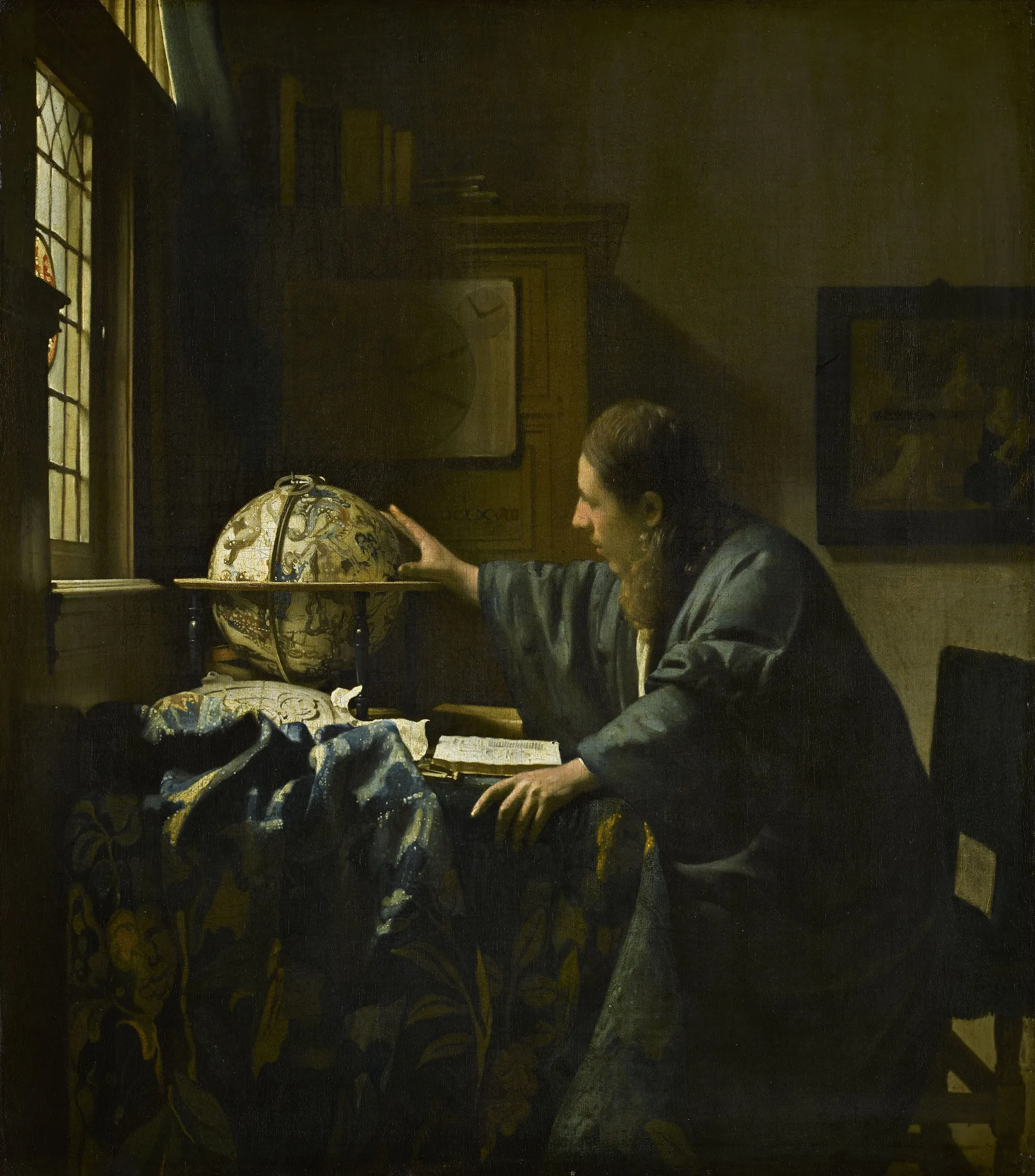
The Astronomer
c. 1668
DESCRIPTION
The Astronomer (Dutch: De astronoom) is a painting finished in about 1668 by the Dutch Golden Age painter Johannes Vermeer. It is in oil on canvas with dimensions 51 cm × 45 cm (20 in × 18 in). Portrayals of scientists were a favourite topic in 17th-century Dutch painting and Vermeer's oeuvre includes both this astronomer and the slightly later The Geographer. Both are believed to portray the same man, possibly Antonie van Leeuwenhoek. A 2017 study indicated that the canvas for the two works came from the same bolt of material, confirming their close relationship. It has been proposed that Vermeer used a camera obscura as an aid to reconstruct the geometry of the rooms and the objects in his paintings. Both paintings portray the same room and furniture, slightly rearranged. The painting shows an astronomer looking at a globe. The astronomer's profession is shown by the celestial globe (version by Jodocus Hondius) and the book on the table, the 1621 edition of Adriaan Metius's Institutiones Astronomicae Geographicae. Symbolically, the volume is open to Book III, a section advising the astronomer to seek "inspiration from God," and the painting on the wall shows the Finding of Moses—Moses may represent knowledge and science ("learned in all the wisdom of the Egyptians"). It is notable that a telescope is absent from the scene; Jacob Metius is credited by his brother, Adriaan Metius, as the inventor of the telescope. Art historian Julian Jason Haladyn has suggested that this conveys interiority.
DETAILS
Original title: De astronoom (Dutch)
Dimensions: W45cm x H51cm
Movement(s): Dutch Golden Age
Medium(s): Oil on canvas
Genre(s): Figure painting
MUSEUM