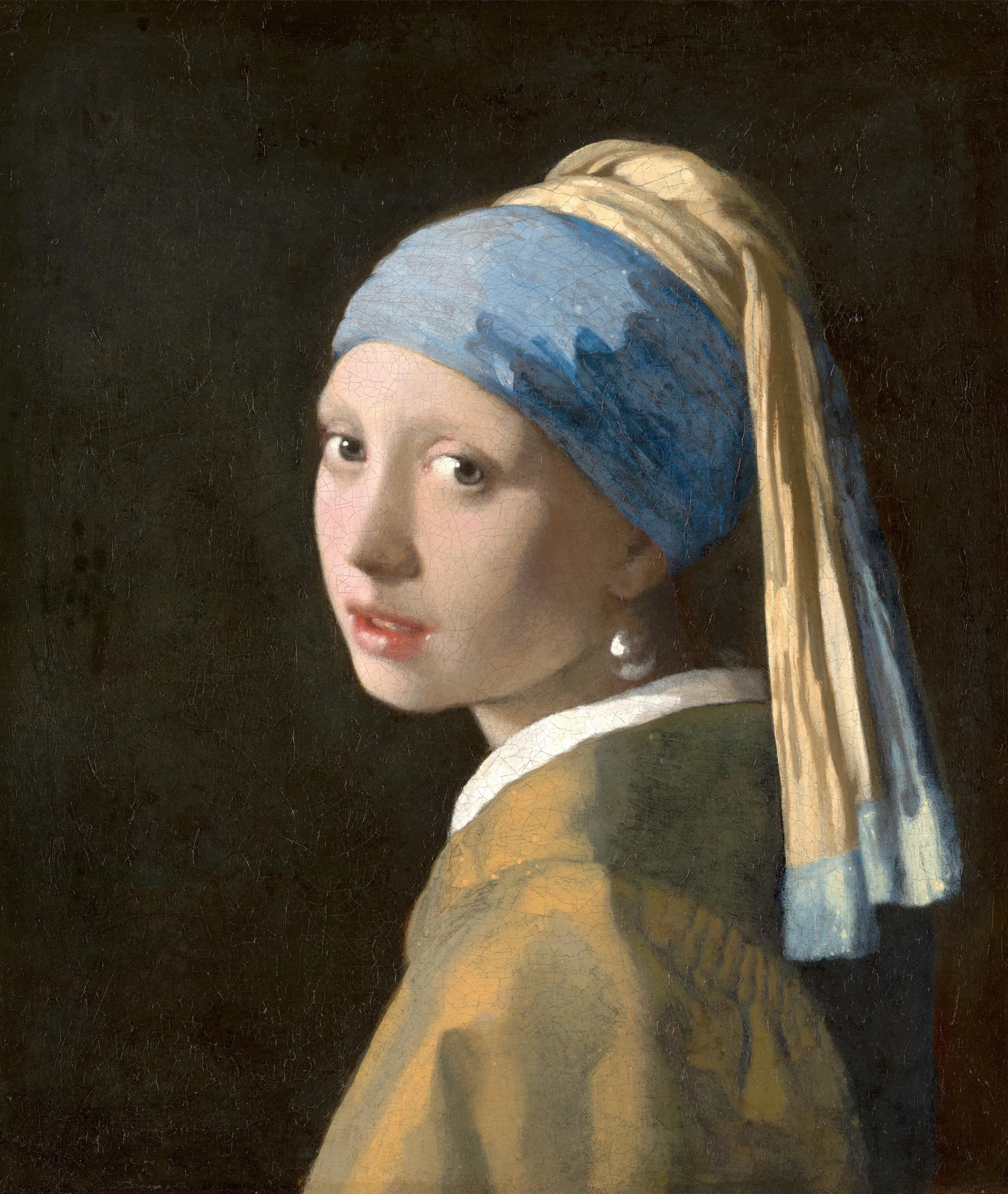
Girl with a Pearl Earring
c. 1665
DESCRIPTION
Girl with a Pearl Earring (Dutch: Meisje met de parel) is an oil painting by Dutch Golden Age painter Johannes Vermeer, dated c. 1665. Going by various names over the centuries, it acquired its present title towards the end of the 20th century. The work has been in the collection of the Mauritshuis in The Hague since 1902 and has been the subject of various literary and cinematic treatments. The painting is a tronie, the Dutch 17th-century description of a "head" that was not meant to be a portrait. It depicts a European girl wearing "exotic dress", an "oriental turban", and what appears to be a very large pearl as an earring. The identity of the subject is unknown. She may have been real or imagined, or she might represent a Sibyl or a biblical figure. She has also been said to be the artist's eldest daughter, Maria, though some art historians dismiss this speculation as an anachronism. The work is oil on canvas and is 44.5 cm (17.5 in) tall by 39 cm (15 in) wide. It is signed "IVMeer" but not dated. It is estimated to have been painted around 1665. The most recent (1994) restoration of the painting brought out hidden subtleties in the colour scheme and deepened the intimacy of the girl's gaze towards the viewer. During this process, it was discovered that the dark background, today somewhat mottled, was originally a deep enamel-like green. This effect was produced by applying a thin transparent layer of paint—a glaze—over the black background seen now. However, the two organic pigments of the green glaze, indigo and weld, have faded. In 2014, Dutch astrophysicist Vincent Icke raised doubts about the material of the earring, arguing that it looks more like polished tin than pearl on the grounds of the specular reflection, the pear shape and the large size of the earring. It was claimed in October 2025 that the subject of the painting was Magdalena, the 12-year-old daughter of Vermeer's chief patron Pieter Claesz van Ruijven, who lived in Delft in the Old Town in a house called the Golden Eagle. The family were said to have been Remonstrantist Christians, for whom the biblical Mary Magdalene was an important figure and after whom their daughter was named. It is suggested that the portrait with its biblical style of clothing was painted to commemorate Magdalena's baptism into the church.
DETAILS
Original title: Meisje met de parel (Dutch)
Dimensions: W39cm x H44.5cm
Movement(s): Dutch Golden Age
Medium(s): Oil on canvas
Genre(s): Portrait

MUSEUM