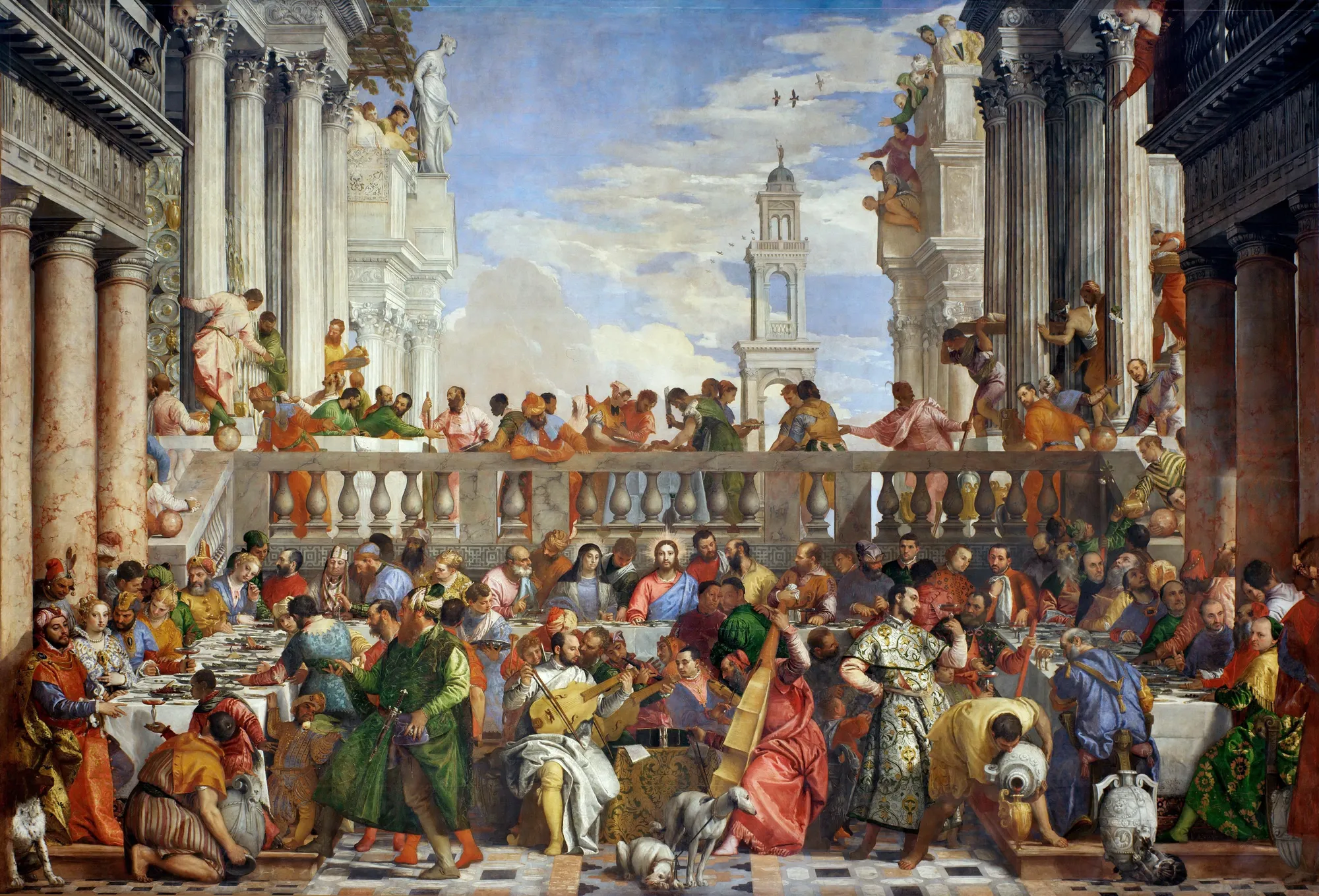
The Wedding at Cana
1563
DESCRIPTION
The Wedding at Cana (Italian: Nozze di Cana, 1562–1563), by Paolo Veronese, is a representational painting that depicts the biblical story of the Wedding at Cana, at which Jesus miraculously converts water into red wine (John 2:1–11). Executed in the Mannerist style (1520–1600) of the late Renaissance, the large-format (6.77 m × 9.94 m or 22 ft 3 in × 32 ft 7 in) oil painting comprehends the stylistic ideal of compositional harmony, as practised by the artists Leonardo, Raphael, and Michelangelo.: 318 The art of the High Renaissance (1490–1527) emphasised human figures of ideal proportions, balanced composition, and beauty, whereas Mannerism exaggerated the Renaissance ideals – of figure, light, and colour – with asymmetric and unnaturally elegant arrangements achieved by flattening the pictorial space and distorting the human figure as an ideal preconception of the subject, rather than as a realistic representation.: 469 The visual tension among the elements of the picture and the thematic instability among the human figures in The Wedding Feast at Cana derive from Veronese's application of technical artifice, the inclusion of sophisticated cultural codes and symbolism (social, religious, theologic), which present a biblical story relevant to the Renaissance viewer and to the contemporary viewer. From the 16th to the 18th centuries, the painting hung in the refectory of the San Giorgio Monastery. In 1797, soldiers of Napoleon's French Revolutionary Army plundered the picture as war booty during the Italian campaigns of the French Revolutionary Wars (1792–1802). The pictorial area (67.29 m2) of the canvas makes The Wedding Feast at Cana the most expansive picture in the paintings collection of the Musée du Louvre.
DETAILS
Original title: Nozze di Cana (Italian)
Dimensions: W994cm x H677cm
Movement(s): High Renaissance, Italian Renaissance, Mannerism
Medium(s): Oil on canvas
Genre(s): Christian Art, Religion
MUSEUM