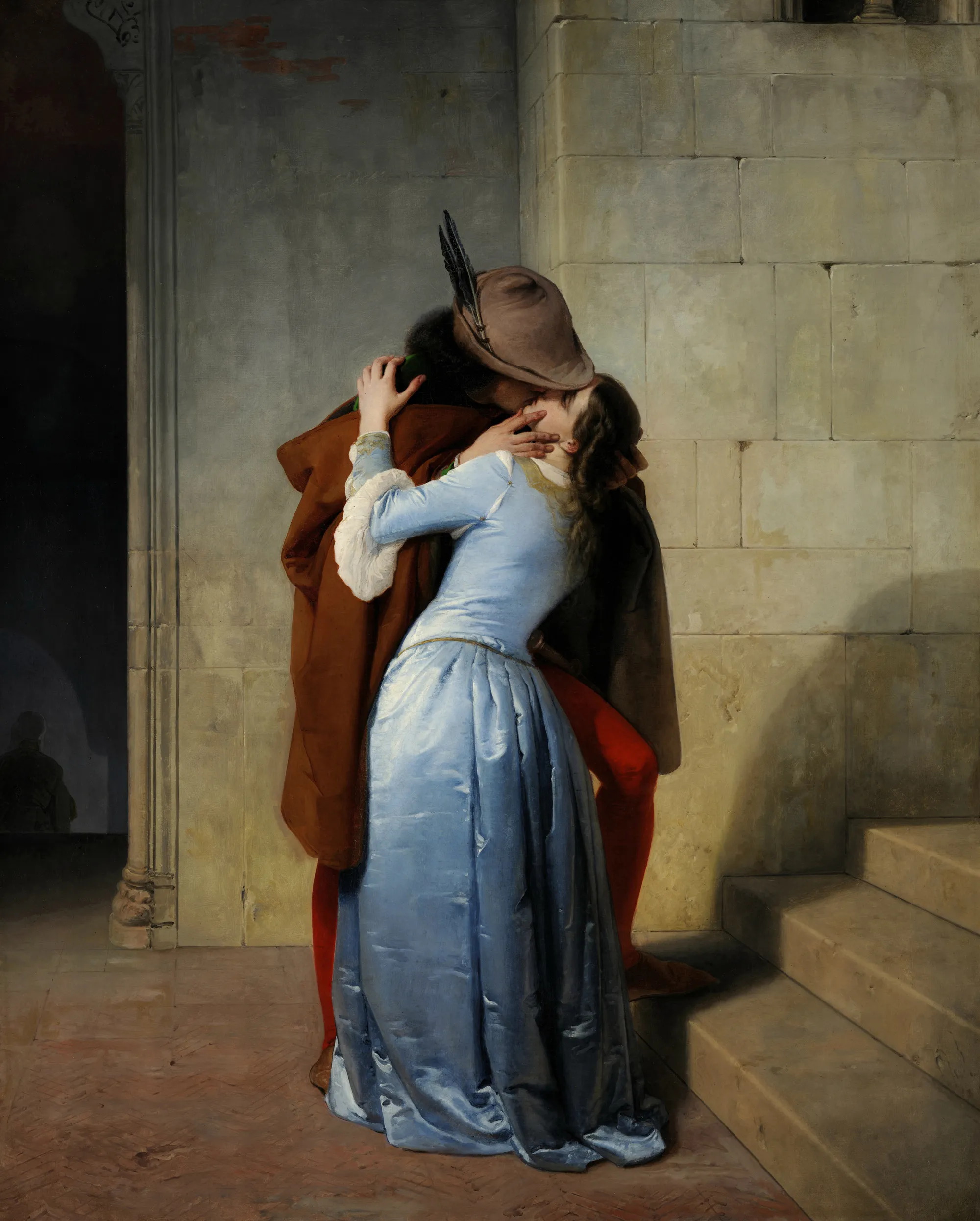
The Kiss
1859
DESCRIPTION
The Kiss (Italian: Il bacio ) is an 1859 painting by the Italian artist Francesco Hayez. Possibly his best-known work, the painting conveys the main features of Italian Romanticism and has come to represent the spirit of the Risorgimento. It was commissioned by Alfonso Maria Visconti di Saliceto, who donated it to the Pinacoteca di Brera after his death. After the defeat of Napoleonic France in the 19th century, the Congress of Vienna was held in 1815 to redraw the map of Europe. Italy had a very marginal role compared to other European countries and was slated to be divided into several states. Every state was ruled directly or strongly influenced by the Habsburgs of the Austrian Empire. That fragmentation went against the growing nationalist sentiment for Italian unification and caused the creation of secret societies with democratic and radical orientations, such as the Carboneria and Young Italy. Although those associations were unsuccessful, their role was fundamental in shaping public opinion. The first war of Italian independence (1848) was a failure, but, by 1859, a secret agreement between Napoleon III and Camillo Benso, Count of Cavour, stipulated the formation of an anti-Austrian alliance. The contribution of France was considered crucial because the Austrian armies were defeated by the alliance in the Kingdom of Lombardy–Venetia in the empire. That victory initiated the unification process, and the Kingdom of Italy was proclaimed a few years later, in 1861. It was during that period that Francesco Hayez painted The Kiss. Mindful of the bloody repression of the nationalist movement, Hayez decided to disguise the ideals of conspiracy and the struggle against the invaders by a representation of past events. The use of ambiguous, opaque metaphors allowed the artist to avoid censorship by the authorities.
DETAILS
Original title: Il bacio (Italian)
Dimensions: W88cm x H110cm
Movement(s): Romanticism
Medium(s): Oil on canvas
Genre(s): Figure painting
ARTIST
MUSEUM