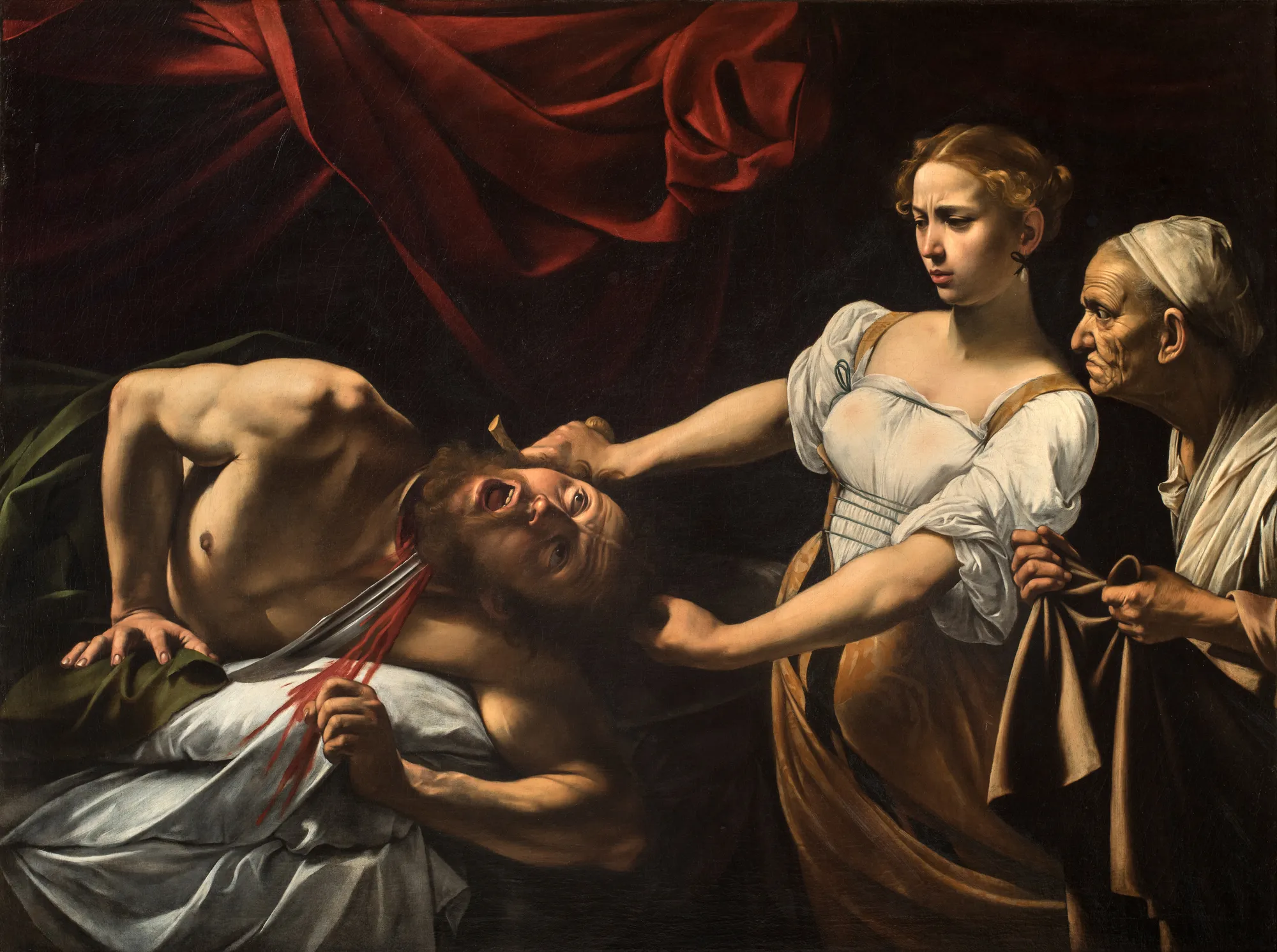
Judith Beheading Holofernes
c. 1598–1599 or 1602
DESCRIPTION
Judith Beheading Holofernes is a painting of the biblical episode by the Italian Baroque artist Caravaggio, painted in c. 1598 – 1599 or 1602, in which the widow Judith stayed with the Assyrian general Holofernes in his tent after a banquet then decapitated him after he passed out drunk. The painting was rediscovered in 1950 and is part of the collection of the Galleria Nazionale d'Arte Antica in Rome. The exhibition 'Dentro Caravaggio', Royal Palace of Milan (Sept 2017 – Jan 2018), suggests a date of 1602 on account of the use of light underlying sketches not seen in Caravaggio's early work but characteristic of his later works. The exhibition catalogue (Skira, 2018, p88) also cites biographer artist Giovanni Pietro Baglione's account that the work was commissioned by Genoese banker Ottavio Costa. A second painting on the same subject (see below) and dated to 1607, attributed by several experts to Caravaggio but still disputed by others, was rediscovered by chance in 2014 and went on sale in June 2019 as Judith and Holofernes.
DETAILS
Original title: Giuditta e Oloferne (Italian)
Dimensions: W195cm x H145cm
Movement(s): Baroque
Medium(s): Oil on canvas
Genre(s): Christian Art